
What Is RAG in AI and Why Is It Important?
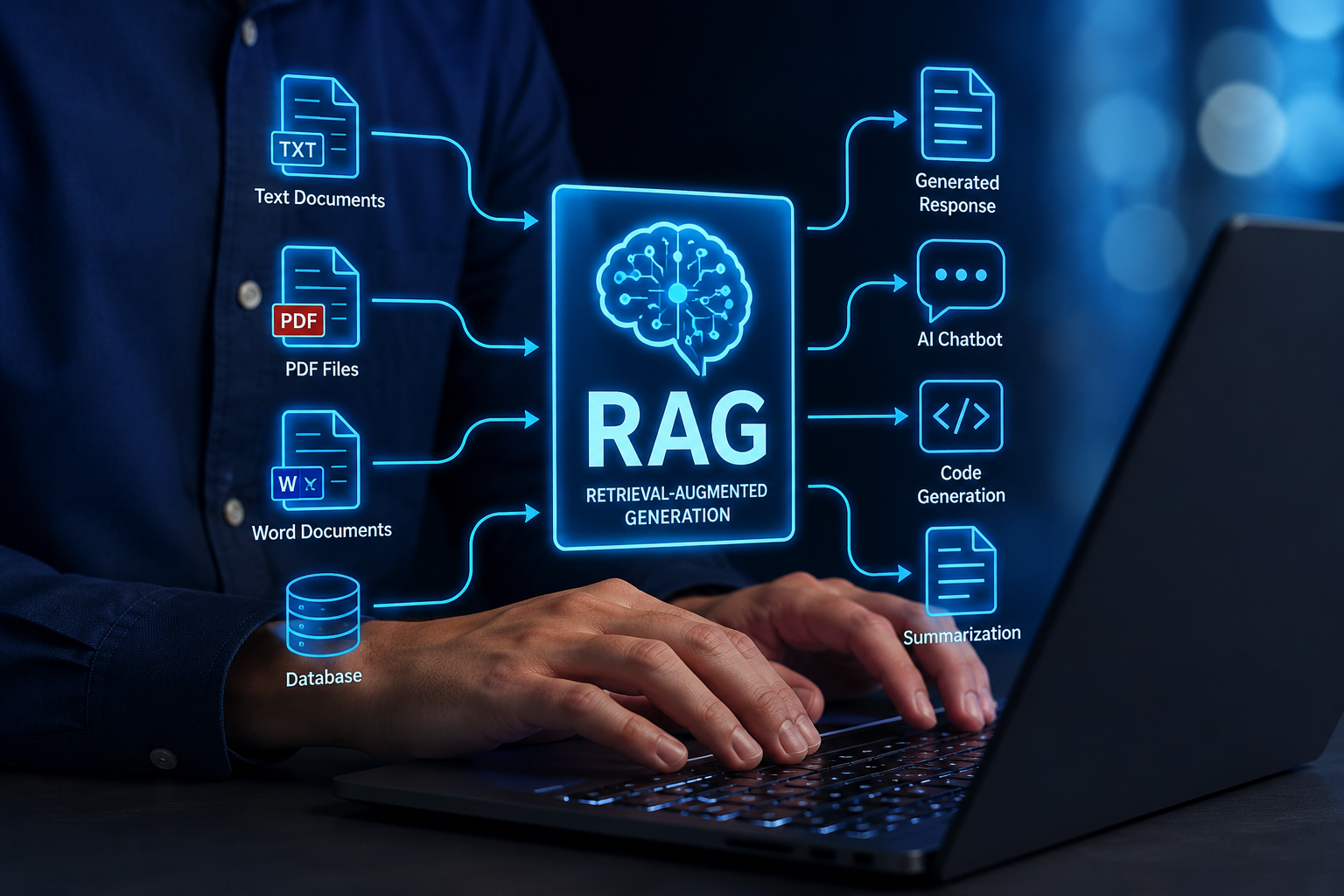
What Is RAG in AI and Why Is It Important?
Retrieval-Augmented Generation (RAG) enhances large language models (LLMs) by allowing them to fetch facts from an external, authoritative knowledge base before generating a response. This cost-effective approach ensures that AI outputs remain highly accurate, relevant, and contextually aware of specific company or niche data without the need for expensive retraining.
Retrieval-Augmented Generation (RAG) optimizes large language model (LLM) outputs by prompting them to consult an external, authoritative knowledge base before responding. While LLMs are highly capable out of the box having been trained on massive datasets to answer questions, translate text, and complete sentences RAG extends these abilities to specific company data or niche domains without the high cost of retraining. This makes RAG a highly efficient solution for keeping AI responses accurate, context-aware, and relevant.
The Challenge of LLMs in Enterprise Applications
Large Language Models (LLMs) are the core artificial intelligence technology driving intelligent chatbots and advanced Natural Language Processing (NLP) solutions. The ultimate goal is to build bots capable of accurately answering user queries across diverse contexts by leveraging authoritative reference data.
However, the inherent nature of LLM architecture introduces unpredictability. Because an LLM's training data is static, its internal knowledge is permanently bound to a specific cutoff date. This limitation leads to several well-documented challenges:
- Hallucinations: Fabricating false information with high confidence when the model lacks the actual answer.
- Stale or Generic Content: Delivering outdated or broad responses when a user requires current, specific insights.
- Unreliable Sourcing: Generating answers derived from non-authoritative or untrustworthy data.
- Contextual Confusion: Producing inaccurate responses due to terminology conflicts, where different training sources use identical terms to describe entirely different concepts.
The Analogy: You can think of a standalone LLM as an over-enthusiastic new employee who refuses to keep up with current events, yet answers every question with absolute certainty. In an enterprise environment, this behavior quickly erodes user trust and is unacceptable for customer- or employee-facing chatbots.
Mitigating LLM Limitations with RAG
Retrieval-Augmented Generation (RAG) is a highly effective architecture designed to overcome these limitations. Instead of relying solely on internal weights, RAG forces the LLM to query and retrieve relevant information from vetted, pre-determined, and authoritative knowledge repositories.
By implementing RAG, organizations gain precise control over the AI's generated output, while users receive verifiable, transparent insights into exactly how the model formulated its response.
What is Retrieval-Augmented Generation?
Retrieval-Augmented Generation (RAG) is the process of optimizing the output of a large language model, so it references an authoritative knowledge base outside of its training data sources before generating a response. Large Language Models (LLMs) are trained on vast volumes of data and use billions of parameters to generate original output for tasks like answering questions, translating languages, and completing sentences. RAG extends the already powerful capabilities of LLMs to specific domains or an organization's internal knowledge base, all without the need to retrain the model. It is a cost-effective approach to improving LLM output so it remains relevant, accurate, and useful in various contexts.
Why is Retrieval-Augmented Generation important?
LLMs are a key artificial intelligence (AI) technology powering intelligent chatbots and other natural language processing (NLP) applications. The goal is to create bots that can answer user questions in various contexts by cross-referencing authoritative knowledge sources. Unfortunately, the nature of LLM technology introduces unpredictability in LLM responses. Additionally, LLM training data is static and introduces a cut-off date on the knowledge it has.
Known challenges of LLMs include:
- Presenting false information when it does not have the answer.
- Presenting out-of-date or generic information when the user expects a specific, current response.
- Creating a response from non-authoritative sources.
- Creating inaccurate responses due to terminology confusion, wherein different training sources use the same terminology to talk about different things.
You can think of the Large Language Model as an over-enthusiastic new employee who refuses to stay informed with current events but will always answer every question with absolute confidence. Unfortunately, such an attitude can negatively impact user trust and is not something you want your chatbots to emulate!
RAG is one approach to solving some of these challenges. It redirects the LLM to retrieve relevant information from authoritative, pre-determined knowledge sources. Organizations have greater control over the generated text output, and users gain insights into how the LLM generates the response.
What are the benefits of Retrieval-Augmented Generation?
RAG technology brings several benefits to an organization's generative AI efforts.
Cost-effective implementation
Chatbot development typically begins using a foundation model. Foundation models (FMs) are API-accessible LLMs trained on a broad spectrum of generalized and unlabeled data. The computational and financial costs of retraining FMs for organization or domain-specific information are high. RAG is a more cost-effective approach to introducing new data to the LLM. It makes generative artificial intelligence (generative AI) technology more broadly accessible and usable.
Current information
Even if the original training data sources for an LLM are suitable for your needs, it is challenging to maintain relevancy. RAG allows developers to provide the latest research, statistics, or news to the generative models. They can use RAG to connect the LLM directly to live social media feeds, news sites, or other frequently-updated information sources. The LLM can then provide the latest information to the users.
Enhanced user trust
RAG allows the LLM to present accurate information with source attribution. The output can include citations or references to sources. Users can also look up source documents themselves if they require further clarification or more detail. This can increase trust and confidence in your generative AI solution.
More developer control
With RAG, developers can test and improve their chat applications more efficiently. They can control and change the LLM's information sources to adapt to changing requirements or cross-functional usage. Developers can also restrict sensitive information retrieval to different authorization levels and ensure the LLM generates appropriate responses. In addition, they can also troubleshoot and make fixes if the LLM references incorrect information sources for specific questions. Organizations can implement generative AI technology more confidently for a broader range of applications.
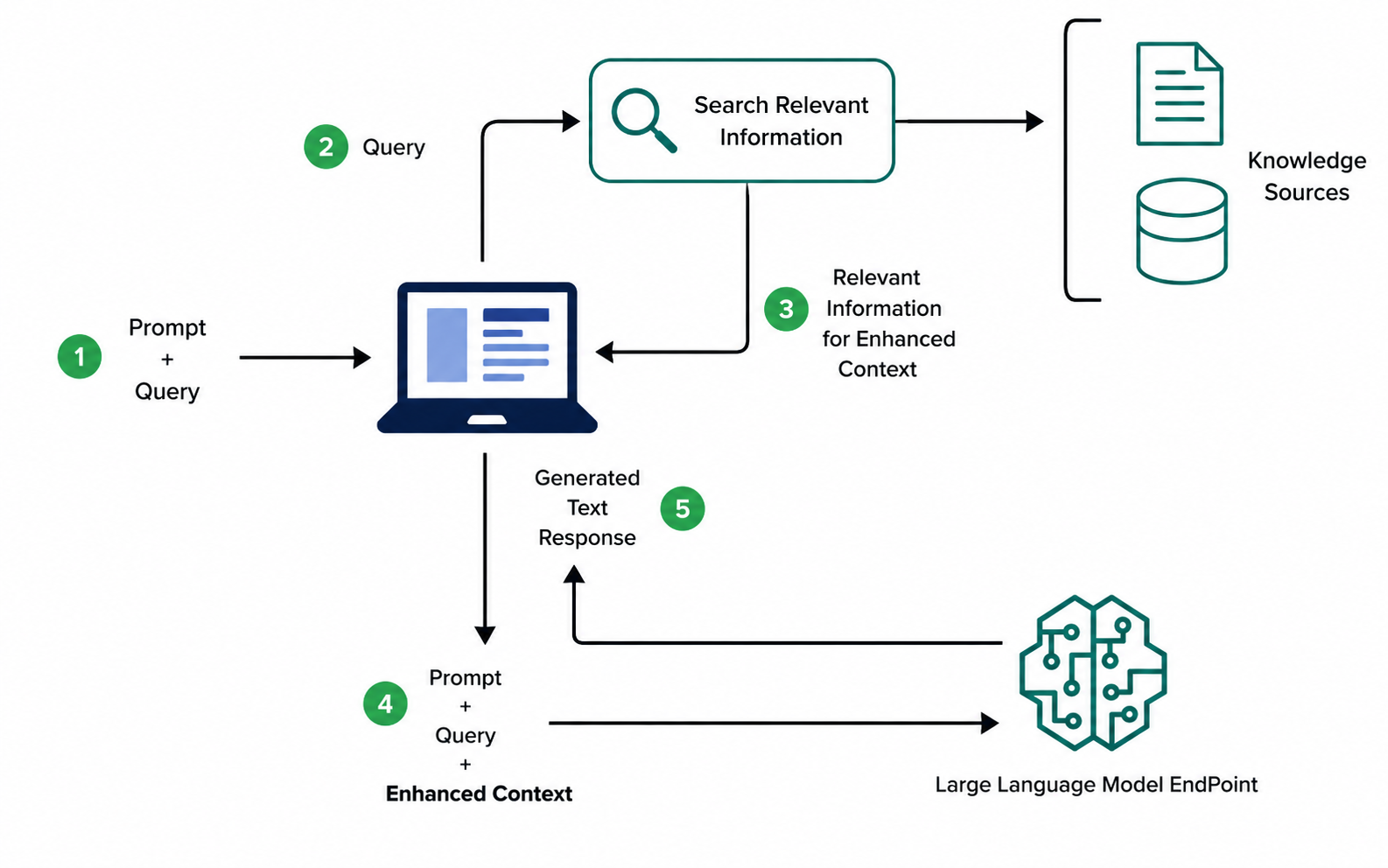
How does Retrieval-Augmented Generation work?
The Strategic Value of RAG
Implementing Retrieval-Augmented Generation (RAG) allows organizations to tailor generative AI to specialized use cases without the prohibitive costs of retraining. By bridging the gaps in a standard machine learning model's core knowledge, RAG ensures more accurate, context-aware outputs.
Key organizational benefits include:
- Cost-efficient AI implementation and AI scaling
- Access to current domain-specific data
- Lower risk of AI hallucinations
- Increased user trust
- Expanded use cases
- Enhanced developer control and model maintenance
- Greater data security